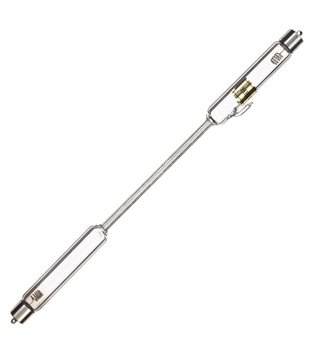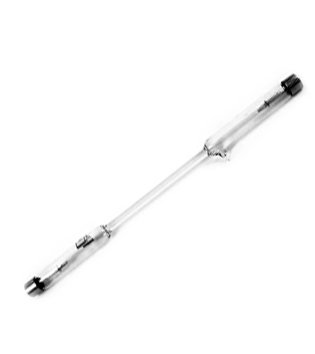
This specialized, low-pressure gas tube is designed to be placed within the poles of a high-field electromagnet for demonstrating the Zeeman Effect. The tube contains a pure elemental gas, typically Mercury (Hg) or Neon (Ne), which is chosen for its clear and well-defined spectral lines (often the Mercury green line at 546.1 nm). When the gas is excited and its light is observed through a high-resolution spectrometer without a magnetic field, a single sharp spectral line is seen. When the powerful magnetic field is applied, the spectral line visibly splits into multiple, closely spaced components (a phenomenon known as the Normal or Anomalous Zeeman Effect), providing direct, observable proof of the quantization of angular momentum in atoms.
Zeeman Effect Demonstration: The primary apparatus for visually and photographically demonstrating the splitting of spectral lines, a cornerstone experiment in quantum mechanics and atomic physics.
High Purity Gas: Contains high-purity Mercury or Neon vapor, selected for their clear spectral signatures and large splitting factors, ensuring observable results even with moderately strong magnets.
High Luminosity: Engineered to provide intense, narrow spectral emission when energized, which is essential for successful resolution of the split lines by a spectrometer.
Compatibility: Specifically designed for insertion into the narrow gap between the pole pieces of a high-field laboratory electromagnet, allowing the light to pass through the magnetic field lines.
Educational Value: Offers an advanced practical method for students to measure the specific charge of the electron ($e/m$) or the Landé g-factor by analyzing the line separation distance.
Tube Type: Low-pressure, narrow-bore gas discharge tube (Geissler tube configuration).
Fill Gas: High-purity Mercury or Neon vapor.
Geometry: Designed with a narrow viewing window to allow the light emission to be observed precisely along or across the axis of the applied magnetic field.
Required External Apparatus: Must be used in conjunction with a Powerful Electromagnet and a High-Resolution Spectrometer.