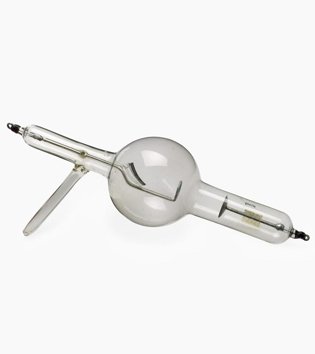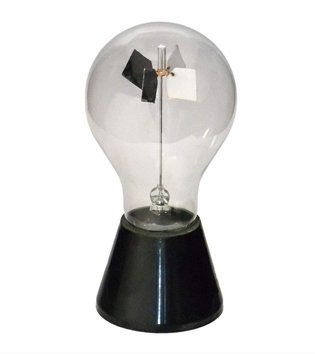
The Radiometer, commonly known as the Crookes Light Mill, is a classic instrument used to visually demonstrate the conversion of light energy into mechanical motion. It consists of a glass bulb from which most of the air has been evacuated, containing a delicate rotor with four lightweight metal vanes mounted on a spindle. Each vane is blackened on one side and polished on the opposite side. When exposed to a strong source of light or radiant heat, the rotor begins to spin rapidly. This motion is caused by the residual gas molecules in the low pressure bulb being heated more effectively by the darker, light absorbing side of the vane. This leads to a molecular push that drives the mill. It is an excellent educational tool for teaching concepts related to radiation pressure and the kinetic theory of gases.
Visual Energy Conversion: Offers a clear and dramatic demonstration of how light and radiant heat energy can be directly converted into mechanical rotational energy.
Kinetic Theory Illustration: Excellent apparatus for illustrating the kinetic theory of gases and the effect of molecular collisions in a low pressure environment.
Sensitive Operation: Highly sensitive rotor design ensures that even low levels of ambient light or heat are sufficient to initiate rotation.
Low Friction Build: Features a precision engineered, low friction spindle bearing to minimize energy loss and maximize the rotor spin speed and duration.
Durable Construction: Built with a robust, evacuated glass bulb to maintain the necessary partial vacuum required for the effect, ensuring long term operational reliability.
Apparatus Type: Evacuated glass bulb with internal rotor assembly.
Rotor Assembly: Four lightweight metal vanes, mounted on a central spindle.
Vane Coating: One side of each vane is blackened and the opposite side is polished.
Required Energy Source: Operates when exposed to any strong source of electromagnetic radiation (visible light, infrared heat).
Internal Pressure: Contains an internal partial vacuum (low pressure), which is essential for the molecular repulsion mechanism to function.